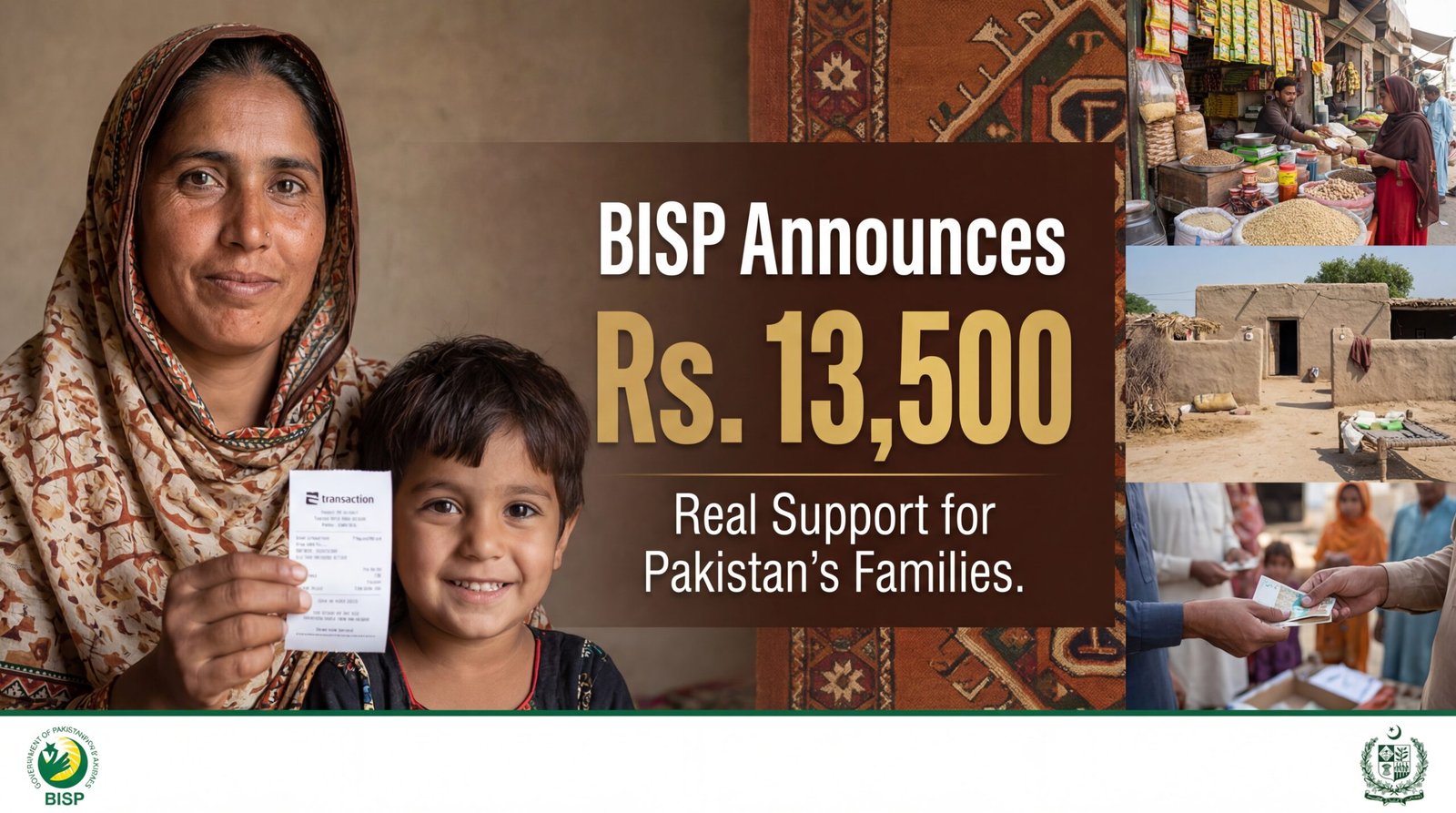
There are government announcements… and then there are announcements that actually make people sit up.
When news broke that the Benazir Income Support Program (BISP) is releasing Rs. 13,500 in financial assistance for eligible families, it didn’t just trend on WhatsApp groups — it moved through villages, katchi abadis, and crowded city neighborhoods like electricity. Because for millions of Pakistani households, Rs. 13,500 isn’t “just money.” It’s survival.
And let’s be honest: in today’s economy, survival itself feels expensive.
This isn’t just another policy update. This is about inflation, dignity, politics, poverty, and whether cash assistance can actually change anything — or if it’s just a temporary bandage on a deep wound.
Let’s talk about it properly.
What Is the Benazir Income Support Program (BISP) – And Why It Still Matters
Benazir Income Support Program was launched in 2008 as a social safety net for low-income families, especially women. Named after former Prime Minister Benazir Bhutto, the program aimed to provide direct cash transfers to the poorest households across Pakistan.
But here’s something people outside policy circles often miss:
BISP isn’t charity.
It’s a lifeline woven into the fragile economic fabric of Pakistan.
Over the years, the program has evolved — biometric verification, digital payments, dynamic surveys, Ehsaas integration, and back again. Governments have changed. Slogans have changed. But poverty? Poverty hasn’t changed nearly as fast.
Today, BISP remains one of Pakistan’s largest poverty alleviation initiatives, targeting millions of women through the Benazir Kafaalat Program.
And now comes the announcement everyone’s talking about:
Rs. 13,500 in financial aid.
Rs. 13,500 – A Small Amount on Paper, A Big Deal in Reality
If you’re reading this from a comfortable office chair, Rs. 13,500 might sound modest.
Let’s break it down in real life terms:
- One month of ration for a small family
- School fees for two children
- Utility bills that otherwise remain unpaid
- Medicine for an elderly parent
- Rent that avoids eviction
Inflation in Pakistan has battered middle-class families. Now imagine the working poor — daily wage laborers, widows, domestic workers, street vendors.
For them, this installment of BISP 13,500 financial assistance is oxygen.
And before critics jump in saying, “It’s not enough,” let’s be clear:
Of course it’s not enough.
But when you’re drowning, even a rope that’s a little thin still matters.
Why the Rs. 13,500 Increase Is Significant Right Now
Timing matters. And this timing isn’t random.
Pakistan is navigating:
- High inflation
- Currency instability
- Rising fuel prices
- Increasing electricity tariffs
- Unemployment pressure
In this climate, expanding or reinforcing cash assistance programs isn’t just welfare — it’s economic damage control.
Direct cash transfers, unlike subsidy systems that leak through corruption or inefficiency, go straight into households. Women receive it. They decide how to spend it. And research globally shows that women-led spending improves child welfare and household stability.
That part? That’s smart policy.
Who Is Eligible for the 13,500 BISP Payment?
Let’s address what everyone is Googling:
Who qualifies for BISP 13,500?
Generally, eligibility is based on:
- Poverty score (via National Socio-Economic Registry – NSER)
- Household income level
- Female headship or vulnerable status
- Verification through NADRA and biometric systems
If you’re already registered under the Benazir Kafaalat program, you are likely eligible for this installment — provided your data is updated and verified.
But here’s a reality check:
Thousands of deserving families remain unregistered.
Why? Lack of awareness. Documentation issues. Survey gaps. Bureaucratic delays.
So while Rs. 13,500 is big news, the bigger question is: Are we reaching everyone who truly needs it?
The Emotional Side No One Talks About
Let me share something.
I once visited a small village near Multan where a widow received BISP payments regularly. She told me something that stuck:
“Beta, paisay se zyada ehsaas milta hai ke sarkar ne humein bhool nahi diya.”
Translation: It’s not just money. It’s the feeling that the state hasn’t forgotten us.
That line carries weight.
Poverty isn’t only about lack of money. It’s about invisibility. When a government sends cash directly to a woman’s account, it says: We see you.
That psychological dignity? You can’t measure it in rupees.
Let’s Be Honest: Is BISP Perfect? No.
We need to talk about the flaws too.
- Delays in payment distribution
- Biometric verification failures
- Technical issues at payment centers
- Middlemen exploitation in some areas
- Complaints about ineligible people receiving aid
These are real problems. Ignoring them doesn’t help.
In some rural areas, women travel miles only to be told their fingerprint didn’t match. In urban slums, agents sometimes demand “service charges” illegally. These cracks in the system weaken trust.
If Rs. 13,500 is going to truly help, the delivery mechanism must be smooth. Transparent. Accessible.
Otherwise frustration replaces relief.
The Political Angle – Let’s Not Pretend It Doesn’t Exist
Social welfare programs in Pakistan are never purely economic. They are political instruments too.
Announcing BISP 13,500 financial aid during economic stress boosts public goodwill. That’s political reality.
But here’s my unpopular opinion:
If politics results in poor families receiving cash, I’ll take it.
Yes, governments benefit from these announcements. Yes, there’s optics involved. But when a mother can buy flour because of that decision, political motivation becomes secondary.
Impact matters more than intention.
APPLY NOW!
How This Impacts Women Specifically
BISP is structured to prioritize women as recipients. That’s powerful.
In many low-income households, men’s income is irregular or controlled by broader family structures. Giving money directly to women increases:
- Household nutrition
- Children’s school attendance
- Health spending
- Financial autonomy
When a woman stands in line, verifies her thumbprint, and receives Rs. 13,500 in her own name — that moment shifts household power dynamics, even if subtly.
It’s not a revolution.
But it’s movement.
Is Rs. 13,500 Enough in 2026’s Economy?
Let’s do a blunt reality check.
With current inflation levels:
- Flour prices have surged
- Electricity bills are unpredictable
- Transport costs are rising
- Cooking oil feels like luxury
Rs. 13,500 won’t transform lives long-term.
It won’t pull families out of poverty permanently.
But that’s not what short-term cash transfers are designed to do.
They stabilize. They cushion shocks. They prevent collapse.
And in fragile economies, preventing collapse is sometimes the most important goal.
The Bigger Question: Can Cash Assistance Reduce Poverty Long-Term?
Here’s where things get interesting.
Critics argue that cash programs create dependency.
Supporters argue they create stability.
I think both arguments oversimplify reality.
Dependency happens when there’s no pathway forward — no job growth, no education, no skill development.
Cash alone doesn’t fix poverty. But poverty without cash is chaos.
The real solution? Combine BISP financial aid with:
- Skill training programs
- Microfinance access
- Women entrepreneurship initiatives
- Education stipends
- Health insurance coverage
Cash is the floor. Not the ceiling.
How to Check BISP 13,500 Payment Status
For those searching practical steps:
- Ensure your CNIC is valid.
- Confirm your registration under BISP or Benazir Kafaalat.
- Check SMS notifications from official BISP channels.
- Visit designated payment centers or camps.
- Avoid paying any “agent fee” — official payments do not require commission.
If someone demands money to release your Rs. 13,500, report them. Corruption eats away at programs meant for the poor.
Inflation Is the Real Villain Here
Let’s zoom out.
Why does Rs. 13,500 feel necessary right now?
Because inflation is squeezing the bottom 40% of Pakistan’s population hard.
When basic food items double in price within months, daily wage earners don’t just struggle — they spiral.
So this financial assistance isn’t happening in a vacuum. It’s a reaction to economic pressure.
If inflation stabilizes, welfare needs reduce. If inflation worsens, even Rs. 13,500 may feel like a drop in a dry well.
Stories Behind the Statistics
We talk about “millions of beneficiaries.”
But every beneficiary is a story.
A mother choosing between medicine and milk.
A father ashamed he can’t provide enough.
A grandmother raising orphaned grandchildren.
When Rs. 13,500 enters that story, it changes decisions for a few weeks.
And sometimes a few weeks of relief is the difference between resilience and despair.
My Take — Bold and Unfiltered
I believe the Benazir Income Support Program 13,500 rupees assistance is necessary.
Not perfect. Not revolutionary. But necessary.
What we shouldn’t do is romanticize it.
If after 15+ years we still rely heavily on cash transfers, it means structural poverty hasn’t been solved. That’s uncomfortable — but true.
At the same time, cutting or minimizing such programs in the name of “self-reliance” would be cruel.
You don’t preach independence to someone who hasn’t eaten.
What Should Happen Next?
If policymakers are serious, they should:
- Expand digital payment transparency
- Update poverty data regularly
- Improve grievance systems
- Link beneficiaries to employment opportunities
- Increase financial literacy among recipients
Rs. 13,500 should be part of a ladder — not a loop.